
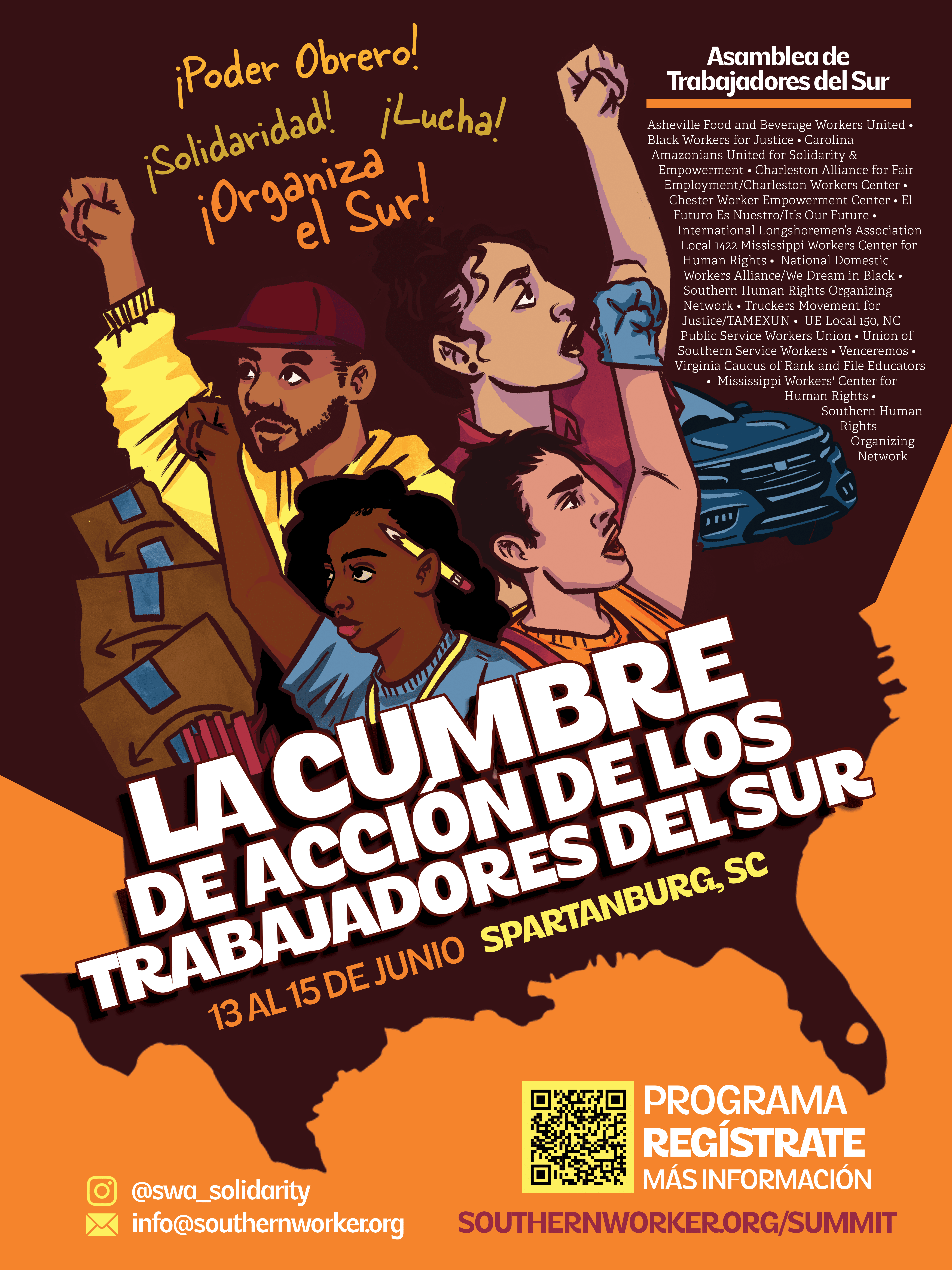
| The Trump administration and the billionaire class have made it clear: they are determined to dismantle our rights and our organizations, lower our quality of life by cutting programs like Medicaid and Social Security to fund tax cuts for the rich and a $1 trillion defense budget, to roll back every measure of progress won through struggle over the last century, and will try to do everything they can to divide us. The U.S. South is the least unionized region of the country, a bulwark of right to work and anti-labor laws. All of the Southern states combined have the same number of union members as the state of New York alone. The region plays a unique role in shaping systemic racism and white supremacy in the U.S. – from slavery, to Jim Crow, to today. It is dominated by some of the most reactionary and backwards forces in the country. Nearly 60% of Black workers in the U.S. live in the South, and the region has the fastest growing population of migrant workers. A new type of workers movement is needed to confront the challenges the working class faces today, one that is engaged in militant struggles that link our fights across workplaces together, and that is focused on building new forms of organization among the unorganized. The Southern Worker Action Summit will be the place to bring our experiences from fights in our workplaces and communities together to begin to lay the foundation for building a workers movement in the South that can do just that. On June 13 – 15, rank and file workers from sectors across Southern states will gather in Spartanburg, SC, discuss, debate, exchange, train, and strategize about how to build an independent, fighting workers movement in the U.S. South. Throughout the weekend, there will be many opportunities for exchanges and strategy discussions among workers in large and small group discussions, sector and state strategy breakouts, trainings and political education sessions, setting out plans to build mass workplace actions on May Day 2028, and more. Sixteen worker organizations building power with workers in key sectors of the economy have worked together to develop the Summit, and we’ll be joined by delegations from workers assemblies, unions, and international workers organizations who will all contribute to the programming and strategy discussions that will take place throughout. Take a look at what’s planned, get general information on the weekend, and register to attend here: https://southernworker.org/summit |
| Why Spartanburg? |
| Spartanburg County sits in the Upstate region of South Carolina, nestled alongside Interstate 85 —the 666-mile-long highway that begins just south of Richmond, VA, and ends in Montgomery, AL. In a July 2024 article about the economic impacts of the interstate, Site Selection Magazine compared its importance to the South’s economy to “what the Transcontinental Railroad was to the entire country 150 years ago,” adding that the corridor is the “region’s undisputed king of commerce.” The Greenville-Spartanburg metro area illustrates this point exceptionally well. What was once a center of textile production in the 1800s and 1900s, has today been transformed into a center of goods manufacturing, particularly in the auto industry. What attracted capital investments from textile manufacturers 100 years ago— abundant land and natural resources, low costs, cheap labor, and low union density—are in many ways the same forces driving the manufacturing boom in the area today. Around the same time that the neoliberal trade regime was decimating the textile industry in South Carolina and elsewhere, BMW announced plans to open a major manufacturing hub in the area. Built in 1994, the plant now employs 11,000 workers and produces 1500 vehicles daily (60% of which are shipped overseas via the dry inland port in Greer which is connected by rail to the Port of Charleston). BMW has invested over $13 billion into the plant since its construction. While BMW stands out as the largest employer, many other major production and warehousing operations have opened in the area over the last 10 years. Given the tremendous amount of production that now occurs in Greenville-Spartanburg, and its reliance on the Greer inland port to quickly move goods to and from the Port of Charleston, the area is a prime bottleneck for domestic and international commerce. From 2023-2024, over $2 billion in capital investments came into the Greenville-Spartanburg area, second only along the I-85 corridor to Fulton County, GA, home of Atlanta. The area is among the top 10 growing multi-county metropolitan areas in the country, and in Spartanburg County, the manufacturing and logistics industries account for nearly a third of employment, well above the national average of about 13%. However, wages for manufacturing workers are well below the national average, with workers taking home around $1380 per week, on average, compared to a national average of nearly $1600 per week. South Carolina has the second lowest union density in the country, with just 2.8% of workers belonging to unions (neighboring North Carolina takes last place with 2.4% density). There has not been a successful effort to win a union recognition election in a workplace of 300 or more workers in the state in at least the last 15 years. |

 Wisconsin Bail Out the People Movement
You must be logged in to post a comment.