
Detroit has been a center of interest and support of the Cuban Revolution for many decades where the majority African American population has engaged in various projects to enhance interactions between both geo-political regions.
A four-day visit by Gisela Arandia Covarrubias and Tomas Fernandez Robaina represented a continuation of a process of cultural exchange. Both individuals are writers and publishers committed to the exposure of the African historical and contemporary presence in Cuba.
Arandia is a researcher associated with the Cuban Union of Artists and Writers. She has traveled extensively in Africa to participate in conferences in Mali and the Republic of South Africa.
Her work has resulted in an appointment as the leader of the Ejecutivo, ARAC (Articulacion Regional Afrodescendiente de America Latina y el Caribe, Capitulo Cubano), known as a civil rights organization inside the socialist country. She was instrumental in the organizing of the Cuba y los pueblos afrodescendientes en America, a significant conference held in 2011.
Visiting the city as well was Fernandez Robaina, who has worked since the early 1960s at la Biblioteca Nacional (Cuban National Library) in Havana. He also teaches courses at the University of Havana. Fernandez has published widely on issues involving people of African descent since 1968.
In 1994, Fernandez published “The Blacks in Cuba, 1902-1958: Notes on the History of the Struggle against Racial Discrimination.” The author has traveled many times to the United States and Africa gathering information on the similarities between African people in various parts of the globe.
Both Arandia and Fernandez participated in the Student Nonviolent Coordinating Committee (SNCC) Legacy Conference held during early April in Chicago. SNCC, a pioneering and vanguard organization in the Civil Rights and Black Power movements of the 1960s, had emphasized the interconnectedness of liberation efforts in the U.S. and Cuba.
During the late 1960s, SNCC leaders such as Stokely Carmichael (later known as Kwame Ture) and Gwen Patton, traveled to Cuba bringing messages of solidarity seeking support for the African American political movement which had become internationalized by 1967. Veteran SNCC organizers have continued this legacy through annual conferences and other work aimed at achieving total freedom…. https://bit.ly/2UJn1aO
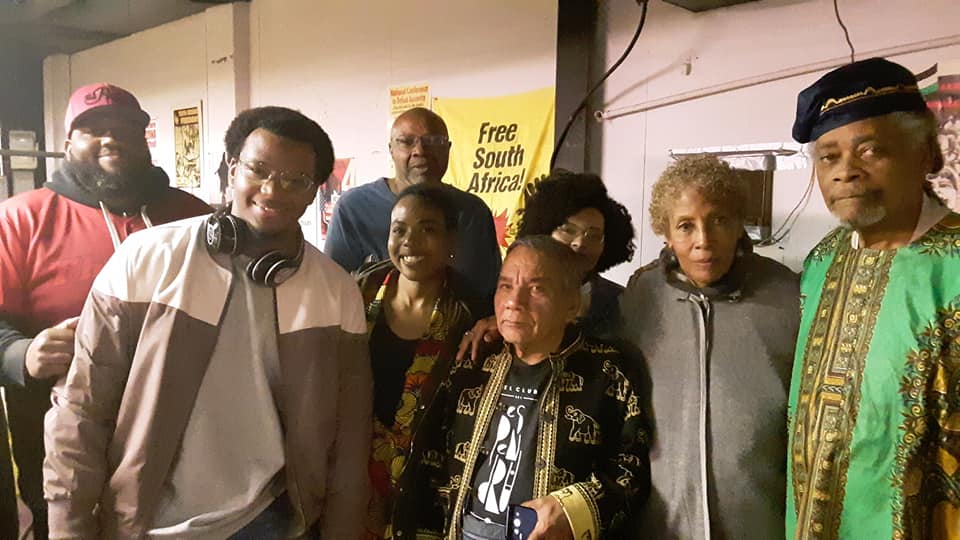
Abayomi Azikiwe along with Cuban guests and friends during the African Presence and the Cuban Revolution Public Forum, April 13, 2019
 Wisconsin Bail Out the People Movement
You must be logged in to post a comment.